Laravel 13 Passwordless Authentication
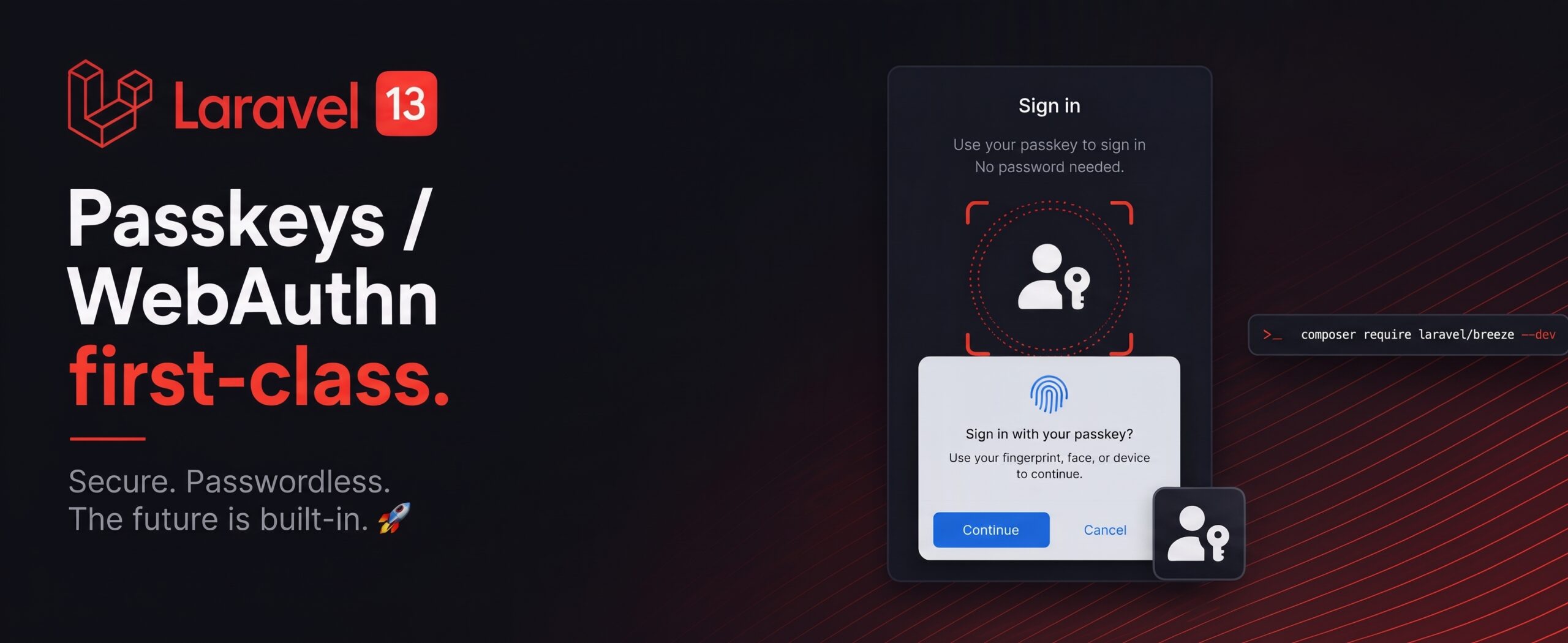
Laravel 13 Passkeys introduce native WebAuthn support, making passwordless authentication easier, more secure, and simpler to implement. Instead of relying solely on passwords, developers can now offer biometric sign-ins and security key authentication with significantly less effort.
Laravel 13 takes a significant step toward a passwordless future by introducing native Passkeys and WebAuthn support. As a result, developers can provide a more secure and frictionless authentication experience with far less effort.
This is one of those framework features that feels like it will quickly become the default choice for many new Laravel applications.
What Are Passkeys?
Passkeys are a passwordless authentication method built on the WebAuthn standard.
Instead of entering an email address and password, users can authenticate using devices and security features they already use every day:
- Face ID
- Touch ID
- Windows Hello
- Fingerprint readers
- Hardware security keys
- Device biometrics
The browser handles the authentication process while users simply approve the sign-in request.
Email + Password
      ↓
Sign In
becomes:
Face ID / Fingerprint
          ↓
Authenticated ✅
Why This Matters
Traditional authentication has always introduced friction.
User forgets password
        ↓
Requests reset link
        ↓
Checks email
        ↓
Creates new password
        ↓
Signs in
Passkeys dramatically simplify that process.
Sign In
    ↓
Fingerprint / Face Scan
    ↓
Done ✅
Users get a faster login experience, support teams deal with fewer password-related tickets, and developers spend less time maintaining authentication flows.
Better Security by Default
Convenience is only part of the story.
Passkeys rely on public-key cryptography rather than shared secrets.
The server stores a public key while the private key remains securely on the user’s device. Since the private key never leaves the device, attackers cannot steal and reuse passwords that do not exist.
This helps protect against several common security threats:
- Credential stuffing attacks
- Password reuse
- Weak passwords
- Many phishing attempts
The strongest security solution is often the one users do not have to think about. Most users will happily use Face ID long before they create a truly strong password.
Laravel Makes Adoption Easy
Historically, implementing WebAuthn often meant researching specifications, installing third-party packages, and building custom authentication flows from scratch.
That extra complexity prevented many projects from adopting passkeys despite their benefits.
Laravel 13 changes that equation by making passkeys feel like a natural part of the framework ecosystem.
composer require laravel/breeze --devFramework-level support means less custom code, better maintainability, and a smoother developer experience overall.
The Real Win
The best framework features are not always the flashy ones.
Sometimes they simply remove an entire category of problems.
Passkeys do exactly that.
When authentication becomes:
Tap
 ↓
Scan
 ↓
Authenticated ✅
everyone benefits:
- Users
- Developers
- Security teams
- Support teams
That is a rare win across the board.
Final Thoughts
Laravel 13 continuing to invest in modern authentication feels like the right move.
For new applications, it is becoming increasingly difficult to justify starting with passwords as the primary authentication mechanism when passkeys offer both a better user experience and stronger security.
The future of authentication may not be better passwords.
It may be no passwords at all.
Join the Newsletter
Sign up for our personalized daily newsletter

#1 GUIDE TO DRUPAL, WORDPRESS, CSS AND CUSTOM CODING | BEGINNER TO PRO



Leave a Reply